Friday, March 02, 2007

POLICE STORY 2


Written by Fantasma el Rey

High flying kicks, a stupendous explosion, and even with a mediocre plot, Jackie Chan’s Police Story 2 is a very enjoyable film. I say it’s due to the genius of Chan himself. His none-too-complicated stories provide more time for his top-of-the-line stunts and stunt team to make more of an impact and for this epic Jackie brought in U.S. pyrotechnics for his grand finale.

This follow-up to Police Story opens with a recap of the events leading to our hero, Chan, being demoted. Because of his offbeat manner of catching criminals, he’s busted down to traffic cop. The mob boss he put in prison is out on the streets again and begins to harass Chan and his longtime girlfriend. Meanwhile, a group of mad bombers are blowing things up around town. Chan quits after a few fights with mob henchmen but is promptly reinstated to help find the bombers, who find a way to kidnap said girlfriend. And it all rolls from there.

That’s about it as far as the plot goes. Our man wins, of course, recovers his girl, and all is well until Police Story 3. Yet it is Jackie Chan’s vision of what Hong Kong cinema could be that hooks you. Chan’s humor is great; a silent, surprising comic vibe fill his films. His Kung-Fu slapstick and desire for bigger and better drive the action to consistently new heights.

The three major fight scenes are awesome. Fight one in the restaurant serves as a true appetizer. The action is good and we know that Chan will do more in the next conflict. Here we notice the superhero image in the background. It’s a kick that the mob boss refers to Chan as “super-hero” or “super-cop,” depending if you’re watching the dubbed version or the original Cantonese with subtitles.

Fight two in the playground is the master fight for P.S. 2 (pardon the pun). Using his environment is a Chan trademark and here it shines like Hong Kong fireworks. Swing sets and monkey bars, it’s all part of the game for this masterful stunt crew. Falling through bars, over each other, and well, all over the damn place as our boy sends them flying in every direction, chasing their tails or fellow goons. Bravo!

Fight three is in the fireworks warehouse. It is with a guy we met a bit earlier, who works for the mad bombers. A weasely chap that looks like no problem for “super-cop,” yet little do we know that this guy kicks like an acrobatic mule. No matter because Chan can take it in stride and figure a way to beat this creep at his own game, by popping small explosives on him.

At this point everyone that’s a hassle is out of the way and Chan has his dame. But wait! During the fight some explosives were knocked over and set ablaze. Now our main man (and women) must run like they have never ran before, for you see the entire warehouse is about to blow sky high and send this one into action-movie history.

This conclusion was the biggest explosion in Hong Kong cinema up to that point. And who put it down on film? Our director Jackie Chan, that’s who. The man rented every camera in Hong Kong to make sure he caught every possible angle. That’s entertainment!

The DVD has some very informative and entertaining special features. The audio commentary by Rush Hour director Brett Ratner and Hong Kong cinema expert Bey Logan is insightful and interesting, with many facts about the filming and a creative look into Chan’s thinking. Logan leads us on an exciting location guide of P.S. 2 and we get to see how these places have changed since the original filming. “Stunts Unlimited” is a fascinating peek at the world of the Jackie Chan stunt team. A good view of how the magic is made and why we keep tuning in to Chan films.

Above all, in anything that Jackie Chan does he brings his honesty and sincerity to the project. It shows in his acting and directing, never settling for mediocrity in his action or comic antics. And that’s what makes him able to turn a simple police story into a blockbuster for the ages. Well, that and the outtakes at the end of his films, which are hilarious and bloody. You gotta love that and marvel at the fact that Chan is still alive after all those crazier than Jackass stunts and mishaps.

Thursday, March 01, 2007

MAN OF THE YEAR


Written by Fumo Verde

I so wanted to see this film but never got the chance, and now that I have, I'm glad I didn't waste ten bucks on doing so. Robin Williams, Christopher Walken, Lewis Black, and Jeff Goldblum make up a cast of high-caliber talent led by director Barry Levinson.
But what went wrong? Sure there was some jokes, some of which were politically funny, but what got lost here? Was the plot about a comedian becoming president via computer fraud too deep for the American public? I desperately wanted to like this movie but I kept getting let down.


Robin Williams gives a good performance along with Christopher Walken. Both men feed off of each other and their energy on the screen together is epic, along with Lewis Black cracking in. When these three men are together, there is some great laughter. This is what kept me going, though I couldn't understand why.


It hit me the second time I watched it. It had nothing to do with cast or direction or even the plot. It had to do with the way this movie was sold. We were waiting for the movie about Jon Stewart from The Daily Show becoming President with Bill Maher as his VP. What we ended up with was Man of the Year. The story falls far short from seeing Stewart rip through the political bullshiters, or Maher lambasting the talking heads of FOX News and the like. No, Man of the Year was a movie about a humorous political talk show host, Dobbs (Williams), who runs for president and leaves his smart-aleck ways back in the studio as he tries to really answer the issues.


To start off, there wasn't much build-up to why or how Dobbs became so idolized. We spend little time with him when he is on his show, and when we catch up with him on the campaign trail, he isn't making the crowds laugh. Although a third-party candidate, he amazingly had a chance to enter the debates. Right then you know this is Hollywood because the Republicans and Democrats would never let a third party in. It isn't until the debate where Dobbs gets a chance to let go and be funny, but like the engine on your old lawnmower it feels like its going to start, then nothing.


During the time we are waiting for Dobbs to go off about the stink of the political winds, we slowly learn that Delacory, the computer company who has given the country the best in electronic voting, has failed to report a glitch in the program. Eleanor Green (Laura Linney), who not only works for Delacory but also invented the system, uncovers it. When she brings it to the attention of her boss, she is dismissed. To cover their own butts in case Eleanor squeals to the press, she is labeled a drug addict and a loony. She decides to tell Dobbs as he starts to fall in love with her. As you can see we have deviated way off the path of "What if Jon Stewart became President?”


When it comes down to it, this movie didn't flop because everything sucked. Actually, nothing in the movie sucked at all. Like I said before, the cast was great, the jokes were funny, and they did get to stick it to the oil companies, kind of, but it wasn't what the audience was looking for. Kind of like the last elections, where most people voted with the thought of "let’s find a new strategy in our foreign policy" and what we ended up getting was more "stay the course."


Man of the Year
is a nice movie, but the American public, and me in particular, were waiting for some hard-hitting comedy concerning the political system in this country and how the people in charge only care about the voters when it's time to vote.


Too bad the film couldn't hit its mark. Maybe if they had marketed differently, or maybe if Hollywood had any balls, they would have come out with a stronger story. Either way, they waffled, be it with comedy or with the voter fraud aspect, the story never got moving, and with a cast of jolly jokers, the studio probably should have let the comedians write the script this time.


As I put this movie on the shelf, I still have a lot of unanswered questions regarding scenes in this movie, but then, as my eye catches the digital clock on the wall, I suddenly remember.... Oh shit, it's time for The Daily Show, gotta get the bong...then later, Bill Maher.

Wednesday, February 28, 2007

THE NUMBER 23


Written by Hombre Divertido

Sometimes you can appreciate a bad film simply for the effort. For example: Hudson Hawk, was bad, but you had to appreciate the effort put into doing something completely different. Not so for The Number 23.

Jim Carrey plays a dogcatcher who becomes obsessed with a book entitled The Number 23. Now, had we been given a story about a man who becomes obsessed with the number 23, as we are lead to believe by the trailers, we might have had something worth investing our time in. In other words: They should have given us the story in the book that our hero becomes obsessed with, rather than his obsession with said story. Still with me? Well, the movie is more convoluted than this paragraph.

Like a joke that takes too long to get to what should be a good punchline, The Number 23 plods along to a conclusion that had potential, yet falls flat due to the lengthy build-up. At 97 minutes, no movie should seem too long, but the set-up is simply not worth the pay-off.

Directed by Joel Schumacher, the film has an interesting look, and that in itself makes it entertaining to watch for a while. The performances are adequate, but Carrey plays it too cute during the far-too-brief establishment of his character, which makes his transition into Jack Nicholson from The Shining too much of a stretch for this thespian. The talented Virginia Madsen is underutilized in this film, and in the industry as a whole, playing Carrey’s wife. What we do get to see of her is the most enjoyable aspect of this film, as her versatility in dual roles serves to hold our attention more than any other aspect of this film. It is a little unclear if the role of the son is poorly written by Fernley Phillips or acted by Logan Lerman. We can probably thank them both for the annoying distraction.

So, Schumacher attempts to tell us not only the story of a family dealing with the patriarch’s obsession with a book and its similarities to his own life, but the story of the book as well, using dual characterizations to weave the two stories together. A reasonable endeavor poorly executed, and too daunting of a task to pull of in 97 minutes. He should have just stuck with an interesting story of how an obsession with the number 23 impacts the life of a man and his family. Might have been better, could not have been worse.

Just too much wasted opportunity here. Good cast, good concept, good film style.

Recommendation: Don’t pay money for this bomb. Wait! That sentence contains 23 letters! AAAAAAHHHHH! Yeah, didn’t really work in the movie either.

Monday, February 26, 2007

The Stanley Brothers: The Definitive Collection (1947-1966)


Written by Fantasma el Rey

Handed down from the Clinch Mountains, via Time Life, comes the first ever comprehensive box set chronicling the entire career of bluegrass legends The Stanley Brothers. The Definitive Collection (1947-1966) will be released just in time to celebrate the 60th anniversary of the Stanley’s first studio recording and surviving brother Ralph’s 80th birthday. The set is to have rare, vintage photos from the ‘40s and ‘50s as well as a biographical essay and an introduction by reigning bluegrass hero/king Ricky Skaggs. All this and three CDs of classic music from the hills of the heart.

“Best of” Stanley Brothers CDs do exist, yet are bound to specific labels that the brothers, Carter and Ralph, recorded for. This collection is the only one to pull from everything that the brothers and their band, The Clinch Mountain Boys, have put down on tape. The untimely death of Carter in 1966 was the only reason that these boys stopped recordings. Some of the tracks are taken from radio shows that the brothers hosted and played on; one such tune even features bluegrass’ founding father Bill Monroe. Also included are five songs which see the “light of disc” for the first time. Fans everywhere will no doubt relish these newly unearthed treasures.

Carter’s strong baritone voice is complemented by Ralph’s high lonesome tenor on song topics that range from love, good times, God, and most prominent: misery and death. Songs of country sorrow abound and these dark classics don’t disappoint. Tracks like “Little Glass Of Wine” and “The Fields Have Turned Brown” have simple lyrics that speak volumes in terms of telling stories of loss in three minutes, while the beautiful sound of hill music drives the scene home.

The harmony shines through especially bright on the heavenly inspired “Get Down On Your Knees And Prey” and a tune I truly dig, “Beautiful Star Of Bethlehem.” All the while acoustic guitars sway, fiddles cry, banjos fly, and the doghouse bass plunks along filling out the sound. On some tunes you can almost hear the wonderful howl of a moonshine jug.

This box isn’t all gloom. The Stanleys show that they can jump with the best of then as well. Fast-paced, toe-tapping, dance-floor fillers are a staple of the Stanley sound to boot. “This Old Home,” “I Just Got Wise,” and “Gonna Paint The Town” are perfect examples of this up-tempo drive. The instrumental numbers which include “Hard Times,” and “Black Mountain Blues” showcase not only the talent of the Stanleys but the ability of the Clinch Mountian Boys to kick it up and soar above the hill tops.

The track that highlights it all is “Orange Blossom,” the drivin’ train song where the furious banjo and fiddles set the stereo to smoking. This hillbilly footstamper is sure to set the woods on fire and be played over and over again. The band gives an excellent feel of movement here, as well as on “Train 45,” which only adds to their ability to get you moving.

All the songs that the public has come to love by The Stanley Brothers take their place along side the more obscure tunes. “I’m A Man Of Constant Sorrow,” “Oh Death,” “Rank Stranger,” “Angel Band,” “How Mountain Girls Can Love” and a nifty cover of Bill Monroe’s “Blue Moon Of Kentucky” are just the tip of the corn stalk. Yes, and let me not forget “How Far To Little Rock,” which is a novelty tune ala Hee-Haw’s pickin’ and grinnin’. A very “hill-arious” look into the lighter side of country life and humor.

The five songs unveiled for this box are true gems which include a live recording captured in 1962 of “Tell Me Why My Daddy Don’t Come Home,” a song that saw life on the Stanleys first ever performance. On “Sugar Coated Love” Carter gets a chance to sing along side his hero Bill Monroe. Two gospel numbers, “Hide Ye In The Blood” and “Dust On The Bible,” continue to show the importance of religion and Christianity on bluegrass music.

Since the 1960s country and bluegrass artists have looked upon the Stanleys with awe, citing them as an inspiration and turning to their music for recording material. Being featured on the soundtrack to the hit film O Brother, Where Are Thou? has led to yet another resurgent wave, one that Ralph Stanley is thankfully still able to ride. Through the years he has kept The Clinch Mountain Boys alive by featuring many talented musicians in their lineup, which now includes his son and grandson. This collection is just about all you need for the Stanley Brothers unless of course you’re a nut like me and have to find more. This is the best place to start and end for most, as this set does cover the entire career from these cornerstones of that ol’ time bluegrass sound.

So finish the jug and start your own band!! See y’all reeel soon.

Sunday, February 25, 2007

Sonny Rollins - Plus 4 & John Coltrane - Traneing In


Written by Fumo Verde

The stars of Rollins and Coltrane were on the rise during the late ‘50s and early ‘60s but it wasn't until recently that jazz musicians and fans have truly realized the impact that these two men had on contemporary jazz. Plus 4 featuring Rollins and Traneing In by Coltrane are two of the finest examples of art in motion, or at least the sound of motion.

First, a glance at Plus 4. This CD features Rollins on tenor sax along with Clifford Brown on trumpet (except track #4), Richie Powell on piano, George Morrow on bass, and Max Roach on drums. It contains five tracks with 32 minutes of swinging jazz, from “Valse Hot” right through to “Pent-Up House.”

Not since Monk had interpreted “Carolina Moon” could anyone else successfully grasp the idea of a jazz-waltz, yet Rollins does it with “Valse Hot.” He makes a waltz feel like you're dancing through the clouds, climbing and reaching with every note. Rollins likes to take notes and stretch them for all they are worth then puts them back all hot and wet. This sweet eight-minute jewel is followed by Sam Coslow’s “Kiss and Run.” The liner notes say that Rollins does more running than kissing in his version, and you can tell that to be a fact as soon as the song starts. Once again his tenor sax is jetting up and down the scales, pulling and pushing on every note in his path. That's Rollins; like our never-ending universe, he is always expanding and stretching forward.

“I Feel A Song Coming On” is another freight train rolling down the tracks at break-neck speed. Rollins and Brown square off for a duel of reed vs. brass as the drums, piano, and bass scurry around to get the best seat in the house to watch the brawl. This song’s energy and drum solos by Roach make it my favorite off the album.

Like a supernova, Plus 4 gets the feet tapping and the heart jumping. Even “Count Your Blessing Instead Of Sheep,” which has a slower tempo than all the others, still gives Rollins the opportunity to push the architecture of how to utilize a tenor sax in a traditional jazz band. To me, I feel that Sonny Rollins is the spirit and the heart of the tenor sax. The tenor sax has a mind and a soul too; it goes by the name of John Coltrane.


Traneing In is another incredible drop of water in the river of music that ran out of John Coltrane. Like Rollins, Coltrane fundamentally changed the way the tenor sax was used in jazz bands, and this is one of those albums that highlight this fact. It is comprised of Red Garland on piano, Paul Chambers on bass, Arthur Taylor on drums, and Coltrane with blueprints for a new era in jazz.

On the title track, Coltrane brings it on strong with a twelve-and-a-half minute jam. The mind of Coltrane takes over here, giving the voice of the sax room to breath, to think about where to flow to next. Coltrane runs the scales also, but with slight pauses before jumping to the next note or two, the anticipation of what follows gives the song its cleverness.

It is followed by “Slow Dance,” which opens with Chambers tickling the bass chords, bringing in a softness that allows Coltrane to cry out this song’s soul with the utmost tenderness. Timing is everything, and Coltrane knows when to let it out and when to keep it in. After a sweet, slow solo Coltrane lets Garland, Chambers, and Taylor take the wheel of the car and follow the route in their own direction, but not for too long.

“Bass Blues” follows, and you would think that the tempo and rhythms would be similar; well, think again. Coltrane gives a jump-start to it by revving up his sax and letting some steam out. Again Coltrane thinks before he steps, and by doing this, he raises the level of play amongst the other musicians.

Does it matter that Rollins has only three original compositions on Plus 4 and that Coltrane has only two on Traneing In? No, because any artist can translate any song, and though the song remains the same, the feeling and images the music brings about will always reflect the musician playing it. On these albums Coltrane and Rollins create from the experiences they have accumulated over their travels. The wisdom gained through other musicians, such as Dizzy Gillespie, Charlie Parker, Lester Young, and Coleman Hawkins and from each other, allowed Coltrane and Rollins to reconfigure how jazz sax should and could be played. They did it with different styles of play, but no matter how you look at it these two men were the pioneers of their time.

These two CDs are a history of how and when John Coltrane and Sonny Rollins started to rearrange the sounds of the tenor sax. Plus 4 and Traneing In are two very different CDs by two very different musicians who showed the world that anything is possible.

Friday, February 16, 2007

THE MESSENGERS


Written by Hombre Divertido

The Messengers fail to deliver.

If you have seen The Birds, Poltergeist, Amityville Horror, The Shining, and The Sixth Sense, than you have seen pieces of The Messengers done much better. This is an eighty-five minute concoction of other stories thrown together into a haunted house tale that hits every cliché possible.

The kids are attacked by dead people, know one believes them, they continue to stay in the house, and model behavior that know normal person ever would. A character is introduced from out of the blue that is sure to be key piece of the puzzle, and the big reveal at the end falls as flat as the performances in this film.

I would at least like to tell you that this is good brain candy i.e.: Leave your brain in the car, and go watch a movie that will make you jump every ten minutes, but The Messengers even fails on that front.

The biggest problem here is a complete lack of depth. The standard opening segment where we see what happened in the house prior to the arrival of our victim family is far too vague, as are the eventual attacks to the family. We’re not sure who or what is doing the nasty deeds, nor do we understand why. The writer and director fail to understand that part of the enjoyment gleaned from an audience stems from a desire to figure things out while grasping the rafters after being scared out of our seats. There are no such rafter-grabbing moments in this film, nor is there anything worth trying to figure out.

I could mention the special effects, but you have seen the best ones in the commercials. The majority of that which remains is nothing but computer generated clumsiness. I could mention the actors and make further reference to their performances, but they're all forgettable, and I’m sure they’ll appreciate no further association with this dud.

Recommendation: Send a message back by not paying to see this mess at the theatre or on DVD. Rent Poltergeist and The Birds for much more fun.

Thursday, February 15, 2007

David Martin: Something In Your Eyes


Written by Fumo Verde

Oh boy, here we go again. This one is for the little girls, and his name is David Martin. Martin is a blonde, blue-eye heartthrob with the voice of an angel. Looking like an advertising model for Polo, David Martin brings us his first CD Something In Your Eyes, which is a disc of love songs dedicated to David's girl, whoever she maybe. I didn't try to find out.

Let it be known that Martin wrote all these songs, and that this CD is all about love. Yes, Mr. Martin is a lover, but you wouldn't know that by the look of the CD cover. The title song opens up with only a piano, drums, and Martin’s voice, softly explaining his love for the woman who still holds him in awe. It is a remembrance piece that sounds more like the love theme to a cheesy ‘70s movie. Actually, all of these songs have that type of imprint, but that's because Martin's philosophy is all about relationships. "Our Love" truly shows this. The lyrics start off with Martin revealing things he loves, such as the smell of rain, watching the seasons change, and snow melting in his hair, until he lets his true feelings be heard. "Our Love is our love, and girl, I love our love." With deep lyrics like that, I won't forget my skim board.

This whole CD seems hollow and predictable with each song trying to out sap the other. Yes, love is great, but what makes a great love song is the love that has flourished with that special song in mind. But I'm no love doctor and neither is David Martin. His voice does the lyrics justice, but I just couldn't connect with anything that he was saying. His website describes him as being like one of the love-song writers of the ‘70s and ‘80s; i.e. Billy Joel and Sting, but those guys wrote more than love songs. Even more so, they wrote about the pains of love, not just how much they loved that person. The CD is dedicated to "his Girl," or at least that's what it says on the back of the liner notes.

There is nothing wrong with this CD; it's just nine songs dedicated to David Martin's girl and one song dedicated to his Lord. The music is played well, and the lyrics are sung with passion. Some very accomplished musicians back Martin and this gives the music its fullness, but that's about it. Maybe, in the future if David Martin comes out with something other that drippy-sappy love songs I might find more of a connection. I know a car accident helped Drake Bell.

Unless you're a teenage girl, or a very emotional woman at any age, this CD may not be your cup of tea. I only do tea with shrooms, and even that wouldn't have helped here.

Wednesday, February 14, 2007

BECAUSE I SAID SO


Written by Hombre Divertido

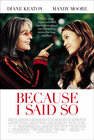
Because I Said So starring Diane Keaton and Mandy Moore, and directed by Michael Lehmann, is a contrived and convoluted story full of cute competent performances. Unfortunately, said performances are not enough to make this work regardless of who says so.

It is impossible to ignore the talent of Diane Keaton even in such a poor vehicle as Because I Said So where she is an overbearing mother set on marrying off the youngest of her three daughters played enjoyably albeit one dimensional by Mandy Moore. Keaton’s “Daphne”runs a lengthy personal ad and sets out to interview candidates for her daughter.

After the standard run through of bizarre characters, she decides on “Jason,” the rich architect played by horribly miscast Tom Everett Scott, who needs to find more quirky roles that better fit his look and abilities. During the process of finding Jason, Daphne also meets “Johnny” (Gabriel Macht) the musician who is all wrong for her daughter.

So Moore's character meets and starts dating both, and the majority of you can finish the story yourself, as could the majority of people who see the film since it is quite predictable, and full of clichés that we have seen in far too many superior films.

Lauren Graham and Piper Perabo play Daphne’s other two daughters, who seem to be either dressing or undressing in a number of scenes, and do nothing more than stand around and shrug their shoulders, or smile knowingly throughout the film.

These 109 minutes of film might make four episodes of a decent situation comedy, but as a motion picture, it is too predictable, and wastes the talent of its gifted cast.

Recommendation: If not for the comedic talent of Keaton who reaches the point of virtually mugging to the camera in an effort to make poorly directed physically comedic scenes remotely humorous, and a cute performance by Moore who appears to be developing in to bankable adult actor who needs some help with script selection, this outing would be a complete waste of time. Since the actors work so hard to make a poorly directed script work, this DVD is worth a rental at your local rental shop, but not something you should pay to see at the theatre.

Tuesday, February 13, 2007

Cracker/Camper Van Beethoven: First Annual Camp Out Live


Written by Fantasma el Rey

From out of “California’s High Desert” comes Cracker with Camper Van Beethoven and friends filmed at “The first annual camp out live at Pappy and Harriet’s Pioneertown Palace.” Where ever the hell that is? To be perfectly honest, I don’t care. For you see, joining these mavericks of alt-country are the side projects and solo outings by the likes of Johnny Hickman, Victor Krummenacher, and the ominous sounding Monks Of Doom. Along the way a few other band members get shine time of their own. Connecting all the offshoot bands together, besides their involvement with one of the two core bands, are their alternative country/ cow-punk sound.

The disk kicks off with CVB launching directly into “The Long Plastic Hallway” and moving quickly into “Tania” and that’s when things get good. “Tania” is where the sound of CVB is captured best, described as a band of gypsies (not the Jimi Hendrix band) meets the Charlie Daniels Band. Fiddles and mandolins soar as the solid rhythm section keeps time with lead singer and co-founder David Lowery’s vocals. The momentum keeps going as the band slides smoothly into “Eye Of Fatima Pt. I–II” and, as with most two-part tunes, this one turns into and ends as a raucous jam.

The last two songs are truly where it’s at for CVB. The thundering country rocker “51-7” is where the band comes together and lets it all roll. “Take The Skinheads Bowling” is the cult classic that is seemingly a solution to a social concern, yet it’s not. In fact it’s pretty much a little ditty about nothing at all. But it sure is fun to sing along with when you can find it.

The second act on this DVD is a complete change of pace: the acoustic set by Cracker’s guitar-slinging, songwriter Johnny Hickman. Accompanied only by his guitar and harmonica, Johnny captivates the audience with three tunes written in a Dylan-esque style. “The Great Decline,” “Beauregarde’s Retreat,” and “Little Tom” are awesome tunes that showcase Hickman’s writing style and his “tuff” baritone voice. “The Great Decline” is a remembrance of things past and contains a good line about our politicians being drunk with greed. While “Beauregarde’s Retreat” is his happy song about the simple things in life and not being distracted from the light. I say “happy” because as Hickman himself points out, his songs have a tendency to be a bit on the darker side of things. A good example is “Little Tom” about those who fall through the cracks. With this review and my previous one on Cracker, I am now a real Johnny Hickman fan and must search out his solo work

On to CVB’s Victor Krummenacher who punches in with his three moody alt. country numbers: “Not Coming Back,” “Bittersweet,” and “Questa Sunset.” The drums are steady and heavy, adding to the gloom as the steel guitar gently weeps behind the guitars. Victor’s dark country baritone carries his tunes easily to your ears and leaves you wanting to hear more than is given on this disc.

Krummenacher returns to team up with original CVB member Chris Pederson and checks in with their band “Monks Of Doom,” where things are sent spinning. Their heavy blues-rock meets alt-country stands out from the other bands on this disc. Krummenacher leads the band on “Poison” while Pederson takes vocal duties on the Stevie Ray Vaughan-inspired “Riverbed.” Drums crash and guitars flash as the Monks tear through the two songs. Too bad that’s all they have is all I’ve got to say.

Rounding out the solo performances is Jonathan Segel, who chimes in with his ten-minute long, southern-rock jam “Little Blue Fish,” and Greg Lisher who has an average country sound. Lisher’s vocals are a bit shaky and soft but pleasant, while his three numbers seem to blend together making it not a bad performance, just one that seems drowned out.

Lowery, Hickman, Krummenacher and Pederson get back on stage and the stomping is kicked into overdrive, as Cracker hits with the force of Mack truck, fueled by their energized punk/country sound. The band begins by ripping though “One Fine Day” and “Movie Star,” slowing only for “Big Dipper,” then it’s on to the explosive “Teen Angst” and “Low.” Booming drums, steady bass lines, and Hickman’s solid guitar are complimented by the piano and even an accordion. The wild “Teen Angst” and “Low” are as powerful as ever; the boys show that after all these years they have lost nothing. Somewhat sadly the only thing missing from the DVD is the crowd favorite “Euro Trash Girl,” yet it only takes away slightly from the overall excitement of the disc.

Closing out this must-have DVD for fans of Cracker, Camper Van Beethoven, and especially Johnny Hickman is the “Porchstock” footage. Which is an after-hours back-porch performance captured on a home camera, of Hickman and two unidentified guitarists. It’s cool to see Hickman freely and very loosely playing tunes that he admits he hasn’t played in years. This last segment is only flawed by the fact that now and again some drunk guy wonders in front of the camera to sing and curse along with the boys. Very reminiscent of a bad bootleg CD you pick up where throughout, a drunken girl can be heard talking and screaming way too loud.

All in all not a bad way to spend just over two hours enjoying a couple of familiar bands and getting a sampling of a few new ones. Presented with that overall Cracker/CVB vibe of no gimmicks or flash, just sass and kick ass! Now turn out the lights!

Monday, February 12, 2007

Grateful Dead: Live at the Cow Palace New Year's Eve 1976


Written by Fumo Verde

This one's probably just for the Heads but others who are getting into the jam side of rock and roll and bluegrass will dig this one also. It's live Dead, but unlike some of the bootleg tapes and CDs that sound like bootleg tapes, Live at the Cow Palace New Years Eve 1976 is as clear as a cowbell, and you can always use more cowbell. I read on the Dead's official site that this CD is recorded in HD. What will they think of next?

Now I'm not getting into a pissing match about if this is or isn't one of the best shows that they have ever done. I'm not like that; I just dig the music, and these three discs have that in abundance. The band sounds tight and the recording crew did a great job. I don't have an HD player of any sort, but I would be impressed if these discs sounded any better than they do on my standard equipment because all of these discs sound great for a live show.

This show comes off smoothly with Jerry Garcia and Bob Weir singing so in tune, not just with the lyrics and instruments, but also with each other. “Studio quality sound” is the best way for me to describe it. With Jerry howling soulfully and Bob’s vocals following right behind on “They Love Each Other,” the band takes the audience to a deeper blue than normal bluegrass.

The next song, “Looks Like Rain”, is one of my favorites and it follows masterfully behind “They Love Each Other”. Normally, Jerry is considered the soulful one, but those first words out of Bob’s mouth gave me chills and goose bumps. All this soul laid out to the backdrop of the gentle yet sturdy driving sound of Phil Lesh’s bass. Billy Kreutzmann and Mickey Hart exchange drum rips while Donna Godchaux’s voice shines throughout, and not just on this track, but the whole show. On this track you can see why the Dead needed her as much as they did. This is just a small micro look at this grand package of a show and of the band at that time.

I would have to say that this show was more bluegrass than rock or just outright jamming. The Dead have always used the jam trip to blend and mix genres of music. They can take a hard rocking song and give it a bluegrass-jazz feel, or take a traditional bluegrass or country song and give it a rock and roll soul with some psychedelic jamming. “Playing in the Band” has this type of flair to it. Guitars, keyboards, Phil’s bass, all the instruments head out for an adventure at this point of the show, and what a trip it is. Is it organized improv or just a chance for everyone to tune up again, or was the acid that good? I think I’ve made my decision.

“Eyes of the World,” “Wharf Rat,” “Scarlet Begonias,” and “Morning Dew” are just a few out of the twenty-two tracks divided up amongst three discs. I have to say, this was one of the most soulful sounding versions of “Wharf Rat” I have ever heard. This set also has one of the shortest versions of “Eyes of the World,” which is one of my all-time favorites because it’s true that “sometimes we live no particular way but our own.” The jam from “Eyes…” to “Wharf Rat” flows with only the magic that Grateful Dead can conjure up.

Of course, there is a “Drum” track, and from it the band drops into “Not Fade Away,” followed by “Morning Dew.” Do I have a problem with slower versions of “Bertha,” “Scarlet Begonias,” or “One More Saturday Night”? No I don't, and I actually like slower tempos on tunes such as those. When played with a slower beat or tempo, it gives the song a new spirit and can sometimes come off stronger than when first heard at its original rhythm. This is what live performances sound like, and this feeling can be felt on these CDs. Things like the cheers from the crowd can be softly heard during the song, but as the band stops or "tunes down" during transitions, the crowd sound gets a little louder, bringing the listener into the Cow Palace to enjoy the vibe that's going around.

Like I said, I'm not going to debate whether or not this one of those "special" shows, but from the sounds I have heard of these discs, I sure wish I had been at this show. What makes a great band isn’t just the music they make in the studio, but how well they can perform it live in front of people. The Grateful Dead have that ability; Live at the Cow Palace proves it.