Showing posts with label El Conquistadorko. Show all posts

Tuesday, January 22, 2008

Zodiac - The Director's Cut (Two-Disc Special Collector's Edition)


Written by El Conquistadorko


It all started in Novato, a working class suburb of San Francisco, on July 4, 1969. Two teenagers, Darlene Ferrin and Mike Mageau, are making out in their car at a lover's lane cul de sac, when a car speeds along the road towards them. Ferrin has a jealous ex-boyfriend, and she's convinced he's been following her around. The car pulls up and idles menacingly ten feet away, its headlights blinding the couple. Then it speeds away. And then the car returns, a man of average height and build jumps out, walks calmly toward Ferrin and Mageau, and starts shooting.

Ferrin died of her injuries but miraculously Mageau survived. Ferrin's supposed boyfriend had nothing to do with the murder; there's no indication he even existed. But a few days later, a letter arrives at the San Francisco Chronicle from the killer, who calls himself Zodiac. Thus begins a crime spree that left five known victims dead and which, along with the Manson family and Altamont, became part of California's dark departure from the halcyon 1960s and inspired the fictional serial killer depicted in Dirty Harry. Part of the public fascination with Zodiac is that he left an elaborate web of coded clues to his identity. The other part, of course, is that nobody ever completely cracked the code and caught the guy.

It doesn't ruin the enjoyment of watching Zodiac to know all this from the get-go. In fact, the lack of resolution in this film is exactly what makes it so intriguing and terrifying. Director David Finch's masterful storytelling propels what in many ways is one of the most subdued thrillers ever made, a film where the actual murders, which occur on screen are often less creepy than the scenes where the police and reporters interview suspects who turn out to be innocent.

Zodiac isn't a short film, but unlike Munich, for example, where the cat and mouse game between Israeli commandos and PLO terrorists seems to grind on as long as the Arab-Israeli conflict itself, the film's pacing only grows in intensity as the cops seem to close in on the culprit only to realize they're no closer to finding the killer than when they started. These blind alleys and near-misses are exactly what makes the film so suspenseful and realistic. In fact, as the Director's cut reveals, every detail in the film is based on fact.

The two-disc set comes complete with a feature-length documentary, “Deciphering Zodiac,” that includes exclusive interviews with witnesses, police and even two Zodiac victims who managed to survive their encounters with the killer. There's also a feature, “His Name Was Arthur Leigh Allen,” that profiles David Leigh Allen, and at the end of the film, despite knowing police could never link him to the crime and in fact established he couldn't have been the killer, you still feel like he was involved.

In the film itself, there's one scene toward the end where a San Francisco Chronicle cartoonist played by Jake Gyllenhaal, who helped crack the Zodiac's legendarily bizarre coded messages, which were sent to both the newspaper and police, confronts suspect David Leigh Allen long after police have closed the case and ruled Allen out as a suspect. Allen, played by the normally benign seeming John Carroll Lynch (most recognizable as the wooden duck-painting Norm Gunderson in Fargo), knows that Gyllenhaal's character believes he's the Zodiac and Gyllenhaal's character knows he knows. No words are exchanged, but the scene deserves to be celebrated as one of the most intimately disturbing conversations ever put on film.

Wednesday, January 09, 2008

Che Guevara: Where You'd Never Imagine Him


Written by El Conquistadorko


Che Guevara: Where You'd Never Imagine Him
, a 108-minute documentary by Cuban director Manuel Perez purports to be a surprise-filled expose of the famous Argentinean revolutionary, but it's little more than a propaganda piece that shamelessly aims to use Guevara's legacy to bolster Castro regime's increasingly pathetic efforts to prolong the first and probably last socialist worker's “paradise” in the Western Hemisphere.

It's all the more frustrating because Guevara would be rolling in his grave if he knew the Cuban government was milking his life for propaganda value, seeing as how Guevara quickly figured out Castro was more interested in keeping power in Cuba than using the island as a base to launch a hemisphere-wide uprising. That's why Guevara left Cuba in 1965 for the Congo and finally Bolivia, where he died two years later in an ill-fated effort to inflame local Indians that led to his arrest and execution by CIA-trained Bolivian army rangers.

Anyone interested in learning about the real Che Guevara, the one behind the scraggly goatee and defiant eyes in the posters and t-shirts that have immortalized him should read John Anderson's fantastic biography, Che: A Revolutionary Life, which was published in 1997 and remains the best account of the man. In that book, Anderson provides amazing details on why Guevara was such an interesting persona, and one who, despite being an unrepetentant commie, remains idealized by ideological foes. (In the 1990s, there was even a right-wing death squad in Columbia that named itself after him).

Just one example: as a guerrilla comandante in the hills of eastern Cuba, Guevara would personally execute his own troops if they raped women or looted goods from local villagers, but he'd spare the life of enemy soldiers who fought bravely. If they begged for their lives, however, he'd call them cowards and shoot them. Guevara also made a point of personally carrying out executions of Bautista-aligned officers and policemen who'd been convicted of crimes against humanity in Castro's kangaroo courts. Sure, a lot of those guys had tortured, raped, and murdered innocent Cubans, but as Anderson notes, Guevara seemed to take an almost perverse pleasure in shooting them. The way he saw it, the Cuban revolution would only succeed if it murdered all potential enemies before they could form the inevitable counter-revolution.

It's a lesson he apparently learned in Guatemala five years before the revolution, when the CIA recruited right-wing dissidents in the military led by Colonel Castillo Armas to overthrow the democratically elected Arbenz regime. But you'll hear nothing about any of this in Perez' fawning film, which simply says that the notion that Guevara murdered anyone during Cuba's show trials was an invention of the imperialist US media. The movie does a decent job of tracing Guevara's life from Cordoba, Argentina, where he studied medicine, through his journeys around South America on motorcycle, which have already been chronicled in the enjoyable Motorcycle Diaries, and from there to Guatemala, Cuba, the Congo, and Bolivia.

Just about all the film has to offer is a nice collection of previously unseen archival footage, most of it grainy black and white, and one funny anecdote: Guevara unwittingly volunteered to become president of Cuba's national bank when he was in a room full of head-scratching apparatchicks, one of whom said, “Is anyone in the room an economist?” Che raised his hand. “You're an economist?” the comrade asked, bewildered. “Oh,” Che said. “I thought you said 'communist.'” If there were more such insights to Che's personality, the movie wouldn't come off like the pure propaganda that it is. Someday somebody will make a great film about Che Guevara, one of the most enigmatic and engrossing personalities in the history of the planet, but this isn't it.

Saturday, December 01, 2007

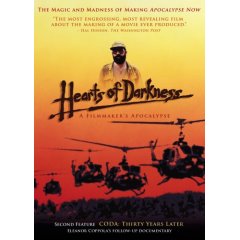
HEARTS OF DARKNESS


Written by El Conquistadorko


With the possible exception of Les Blank's amazing Burden of Dreams, which chronicled German director Werner Herzog's Sisyphean jungle adventure during the filming of Fitzcarraldo, Hearts of Darkness: A Filmmaker's Apocalypse is the best documentary ever made about directing a movie. Directed by Felix Bahr and George Hickenlooper, the film emerged from months of on-location footage and highly personal interviews shot by Eleanor Coppola of her husband, director Francis Ford Coppola, at work on his Vietnam War masterpiece Apocalypse Now.

The first shot of the film is of Coppola bragging to a French audience at the Cannes Film Festival that his movie isn't about Vietnam, it is Vietnam, and although Coppola would regret the pretentiousness of his claim—an embarassment that as it turns out, explains why it took more than 15 years to see this film released on DVD—he wasn't exactly exaggerating. Although miraculously nobody died in the production of the movie, lead actor Martin Sheen suffered a heart attack and most of the rest of the cast and Coppola himself came close to losing their minds in the process.

Many of the actors were drunk or high on LSD, marijuana, or speed during the filming of the movie, Marlon Brando was overweight and half-nuts, Dennis Hopper was completely nuts, and Coppola himself had no idea how his movie was going to end until he finished filming it. The film was completed after more than 200 days of production, nearly bankrupting Coppola, survived a massive typhoon that killed 200 people, and was shot with the cooperation of the Filipino military which let the director borrow several helicopters that frequently flew off-camera to strafe local Marxist rebels.

Originally, Coppola invited his wife to accompany him to the Philippines because he wanted to keep his family with him for what he knew would be an extended overseas trip. But because she was an artist who knew how to hold a camera, and because United Artists wanted a five-minute publicity trailer to show on television, he asked her to do the job. He didn't mind that Eleanor envisioned making a longer film of the production, but wasn't aware that, among other things, his wife was secretly recording his conversations, the most embarrassing of which involves him reacting to Martin Sheen's near-fatal heart attack by telling his Hollywood backers that all he cared about was how quickly he could get his leading man back on the set.

To his credit, Coppola agreed to let the footage shot by his wife become a full-length documentary and never told directors Bahr and Hickenlooper (who took over the project and re-interviewed most of the key players shortly before the film's 1991 release) that they couldn't include unflattering scenes. But as we discover from the DVD commentary, which features both Francis and Eleanor Coppola but seems to have been edited together from separate narrations, he only agreed to that because he thought the film would be shown on television twice before disappearing forever.

Thankfully, although it's been far too long, and this documentary should have been included in Apocalypse Now: The Complete Dossier as a bonus feature, that didn't happen. Besides that, the only legitimate criticisms that can be made about this long-awaited DVD release is that the audio commentary is spectacularly superfluous, adding little information that wasn't already included on Coppola's commentary for The Complete Dossier. And although it does have a lot of talking by Eleanor Coppola, she doesn't have much to add to what she already says in her narration of the documentary itself.

If you're a fan of Apocalypse Now and haven't already seen Hearts of Darkness, you're not really a fan and must buy this now. Just don't expect too many audio commentary revelations and plan on skipping the only other bonus feature, a totally irrelevant making-of documentary by Eleanor of hubby Francis at work on his latest film, Youth Without Youth.

Tuesday, November 20, 2007

CHINATOWN (Special Collector's Edition)


Written by El Conquistadorko


Chinatown
may not the be the best movie ever made—director Roman Polanski doesn't count it as his personal favorite (that honor goes to The Pianist)—but it's certainly among the most compelling films in cinematic history. Released in 1974, the movie actually looks like it was made when it takes place, in Los Angeles circa the Great Depression. It started as an idea by screenwriter Robert Towne, who attended a city hall meeting on a disastrous dam project and got the idea of penning a noir script based on the essence of LA life: water.

Towne envisioned a mystery centering on ex-cop Jake Gittes, who left the force after getting into some kind of unspecified hot water in Chinatown, which Towne figured would make a great script title and mysterious metaphor for the dark forces that really run LA and get away with monstrous crimes in broad daylight—like building a city on stolen water from the Owens River Valley. That particular historical conspiracy serves as the backdrop for what begins as a simple divorce case, when Gittes is hired by someone claiming to be the Evelyn Cross Mulwray, wife of a prominent water engineer, Hollis Mulwray, who suspects her husband of infidelity.

When Gittes leaks photos of the engineer frolicking with a young girl, the real wife, played by Faye Dunaway, confronts him with his mistake. From there, the movie becomes murkier, as Gittes struggles to find out who really hired him, an investigation that quickly turns into a murder probe, as the water engineer is found dead in a dry riverbed. When police determine he actually drowned, the suspense grows and eventually pits Gittes against just about the entire LA power structure, which is ultimately personified by land baron Noah Cross, as chillingly portrayed by John Huston. Crucial to the mystery is the relationship between Cross, Evelyn Mulwray and her husband's “girlfriend,” a puzzle that Gittes solves in one of the most intense bitch-slapping sessions ever put on film.

How Gittes solves the mystery just in time to helplessly stand by as its tragic consequences unfold is a story best left to the film itself, which has never looked as good as it does on this special collector's edition. Amazingly, digital technology does nothing to erode the beautiful Panavision color scheme that (along with Towne's dutiful use of actual, well-preserved LA landmarks like Echo Park) makes the movie look like it was actually shot in the 1930s. Screenwriter Towne apparently realized it was possible to shoot a movie set forty years earlier on location in LA when he read a book published in 1970 called Raymond Chandler's LA, which featured contemporary photographs of architecture dating from that era.

When production of the movie began, Polanski and Towne still hadn't agreed on whether any of the action would take place in Chinatown. In his original script, Towne used Chinatown simply as a metaphor, but Polanski insisted at least one scene had to take place there, and eventually Polanski convinced Towne that the movie's climax should occur in Chinatown. Meanwhile, Towne and Polanski argued well into the filming of the movie, just what should take place in that final scene. Suffice it to say that Polanski's instincts were right on the mark, as Chinatown has one of the most disturbingly and perfectly noir endings of any movie.

Those particular details are just a few of the informational nuggets that come from a trio of bonus featurettes included on this one-disc release. The most interesting, “Chinatown, the Beginning and End” features interviews with Polanski, Nicholson, and Towne, although notably not Dunaway. It reveals that the film (in its inception if not its actual content) was really a buddy picture: Towne, who won the only Oscar for the film, was a roommate in the early 1970s with Nicholson, whose character, Gittes, was named after mutual friend Harry Gittes, an artist and eventual Hollywood producer who went on to produce About Schmidt, which Nicholson starred in.

Nicholson also happened to be friends with Polish director Roman Polanski, whom Nicholson asked to direct Chinatown. Polanski wasn't happy about returning to LA, because a few years earlier, his pregnant wife, actress Sharon Tate, had been murdered by acolytes of hippie cult-leader Charles Manson. Fortunately, Polanski was impressed enough by Towne's script to accept Nicholson's invitation, and after a half-year rewrite session with Towne, they began filming.

The rest, as they say is history, and even though it took 35 years for a collector's edition DVD of one of the best movies in the history of cinema to finally be released—and it doesn't even have a director's commentary—it's worth the wait.

Friday, November 02, 2007

BABEL (Two-Disc Special Collector's Edition)


Written by El Conquistadorko

One of the best movies to hit screens in the past several years, Alejandro Gonzalez Inarritu's 2006 film weaves together three stories—a pair of Moroccan brothers who fatefully make contact with an American tourist and later become hunted as terrorists, a deaf Japanese girl whose distant father is surprisingly tied to the incident, and the tourists' two kids who are brought to Tijuana by their maid and run into problems at the border. The movie is the third installment of Mexican director Inarritu's so-called “death trilogy,” following on the heels of the well-crafted Amores Perros and slightly less-than-satisfying 21 Grams.

Without giving too much away, suffice it to say that the gun you see in Act One does get fired, but that the tragic results are not as predictable as you'd think. The movie is a beautiful work of cinematography and masterful storytelling, and although it relies on the same technique of interwoven plot lines that marked Inarritu's first two films, it doesn't use the same anti-chronological device that Inarritu used so well in his debut feature Amores Perros (that whole movie is wrapped around a car crash) but which proved so irksome in 21 Grams. Instead, the movie follows a single trajectory as the camera shifts from one character's perspective to another, following the arc of a single bullet and the investigation that follows from its tragic destruction.

Babel features superb acting performances from Brad Pitt and Cate Blanchett, Boubker Ait El Caid and Said Tarchini (two non-actors who play the Moroccan brothers), and especially Rinko Kikuchi, who gives a convincing and heartbreaking turn as Chieko Wataya, the deaf, sexually frustrated Japanese teenager. It also contains one of the most intensely surreal sequences put on screen in recent memory: a scene where Cheiko and her deaf friends drop acid and stumble grinning, arms interlocked, through Tokyo until they wind up in a public fountain, soaking wet.

The new DVD of the film contains two discs, the second of which includes a feature-length bonus feature—a making-of documentary called “Under Construction.” The documentary kicks off with two American school kids asking Inarritu why he called his movie Babel, at which point he tells them the Biblical story of how God punished mankind for its architectural hubris by forcing them to speak different languages, a more powerful way to divide people than religion, politics or race.

The film traces the movie's production from Morocco to Japan, Mexico and the United States, and is mercifully devoid of the typical mind-numbing celebrity interviews that mar most DVD bonus featurettes, which are about as entertaining as your average daytime TV commercial, although it does include some funny footage of Gael Garcia Bernal clowning around with an American accent, pretending to be a border guard. Instead, the documentary shows Inarritu at work with his actors, most of whom aren't: like the eight teams of deaf-mute Japanese girl volleyball teams he assembled for one scene or the several hundred Mexican actors he used in Tecate to enact a wedding reception scene.

“Under Construction” stands well as its own movie, much in the same fashion as making-of documentaries like Hearts of Darkness about the filming of Apocalypse Now and Les Blank's 1982 film Burden of Dreams, about the making of Werner Herzog's Fitzcarraldo.

Even if you already have the original DVD release of Babel, you might want to consider selling it. The new special edition is worth buying for Disc Two alone.

Thursday, October 04, 2007

John Fogerty: Revival


Written by El Conquistadorko

Back in the 1960s, John Fogerty and his band Creedence Clearwater Revival churned out an incredible series of swampy blues and folk songs so convincingly rootsy that a lot of people still think the band hailed from somewhere in the deep south. Of course, the band was actually part of San Francisco’s psychedelic rock movement and none of its members had even been south of the Mason Dixon Line when they got famous. But what made Creedence truly genius was John Fogerty’s epic lyrics. In anthems like “Effigy,” “Bad Moon Rising,” “Fortunate Son,” and “Who’ll Stop the Rain?” — Fogerty captured the turbulence sweeping America without once singing the words “Vietnam,” “Richard Nixon,” or “flower power.”

Oh what a difference four decades makes. Now, 40 years after the Summer of Love, Fogerty has released his best solo album to date, a straight-forward collection of electric blues and rockabilly-inspired tunes that sounds a lot like Creedence in its heyday. A lot of Revival sounds like pure nostalgia. “Lookin’ out across this town/ kinda makes me wonder how/ all the things that made us great/ got left so far behind,” Fogerty sings in “Gunslinger.” A few songs later, in a song called — groan — “Summer of Love,” Fogerty seems to be trying to say something important about the decade that shook the world, but it’s not clear what. “It was the Summer of Love/ so many people on the move/ flower children lookin’ for the truth/ will they find it or just excuse.”

Huh? Just excuse what? Fogerty never really explains, and instead moves on to more current events in songs like “Long Dark Night.” “Georgie’s in the jungle/ knockin’ on the door/ come to get your children/ wants to have a war.” The rest of the song references Hurricane Katrina — “Brownie’s in the outhouse/ Katrina’s on the line/ Gulf is a disaster/ but Georgie says its fine” — and rips on Bush’s cabinet — “Rummie’s in the kitchen/ messin’ with the pans/ Dickie’s in the back/ stealin’ everything he can.”

Things don’t get a whole lot better on “I Can’t Take it No More,” the album’s closing track. “You know you lied about the casualties/ you know you lied about the WMDs/ you know you lied about the detainees/ all over this world,” Fogerty wails. “Your daddy wrote a check and there you are/ another Fortunate Son.”

It’s hard to disagree with Fogerty’s politics and the music’s pretty damn good, but what America needs now are artists like Fogerty was 40 years ago, folks who can write a good tune and come up with lyrics that reflect the crazy shit that’s happening today, instead of trying to be cute and sounding like an intern at MoveOn.org.

The closest he comes to doing this is on “Don’t You Wish it Was True,” the album’s first song. “I dreamed I walked in Heaven/ just the other night/ there was so much beauty/ so much light/ don’t you wish it was true.” Yes, we do. We just wish the rest of Revival was more like this, and less like John Fogerty trying so hard to be like John Fogerty.