Showing posts with label El Mono Santo. Show all posts

Thursday, May 01, 2008

SOLARIS (1972)


Written by El Mono Santo

We have no interest in conquering any cosmos.
We want to extend the earth to the borders of the cosmos.
We don't know what to do with other worlds.
We don't need other worlds.
We need a mirror...
Man needs man.

--­Snaut

After watching Andrei Tarkovsky's Solaris (not to be confused with the Clooney clone) my love of Stanley Kubrick's 2001: A Space Odyssey waned. Though 2001 preceded it by four years, Solaris makes Kubrick's masterpiece resemble a Hollywood film. The two share many similarities. And yet the similarities seem entirely accidental. Both directors used very different methods of film-making for very different reasons. Perhaps it would be better to call Kubrick's film a "space ballad" and Tarkovsky's a "soul probe." Kubrick's arm reaches forward, out, away from present being to the dream of what we might become. Tarkovksy reaches deep inside to ask what we are.

As the opening quote indicates, Solaris plays with a paradox of human motivation. We turn our heads to the cosmos seeking to uncover it's wonders. "The truth is out there" as The X-Files put it. And yet if there was extra-­terrestrial life - an OTHER kind of life than what we - could we recognize it? Or would we be invariably led, like a Modern Narcissus, to see nothing more than our own reflection? Our concepts of "life" and "being" and "mind" are anthropomorphic. They are contained and given meaning by a frame that is human. But if there was a different frame? In Solaris, that frame is a foreign planetoid or its ocean. Tarkovsky might ask me whether even there I am reducing it to something resembling "the human." At any rate, when human beings came to this deep-space ocean, it reacted.

The main character, Kris, is a scientist sent to the space station to examine its remaining crew and evaluate their psychological standing. Ironically, it will be the scientist, like those he wished to examine, who will be the one psychologically evaluated. Above the churning, morphing ocean of Solaris, contact between humankind and the other is made. And the point of contact is conscience. As the fog of sleep overpowers Kris and the crew, they awake to find that memories etched into their mind by a fingerprint of remorse, guilt, or the tension between ethical/moral dilemma and duty have taken on flesh. We are led to believe, for example, that one crewman, Gibarian, is perpetually haunted by a version of his own perversion - presumably an innocent daughter he blamed himself for molesting. Unable to face a too-­real reflection of his inner demon, Gibarian commits suicide. Caught within his own web of conscience, Kris chooses to embrace it instead of reject it. Will this lead Kris to deeper union with "the other" or further strand him in the island of his own humanity?

In a style similar to Hitchcock's Rope, Tarkovsky limits his cutting and splicing of many scenes. This is done in opposition to his Soviet film-making comrades who wanted to force perspective through their editing. Instead, Tarkovsky leaves us hanging inside the space of the character in near realtime and forces the camera to follow. Truth is thus unveiled through question, not propaganda. Combined with a very minimalistic soundtrack, this stretches out the moments of the film and causes the audience to enter into the self-awareness and meditative ambiance of its characters. And like 2001, there were many instances of incredible cinematic mise-en-scene.

Wednesday, June 06, 2007

LITTLE OTIK


Written by El Mono Santo

Take some classic Svankmajer, throw in Little Shop of Horrors, add a touch of Pinocchio, and the result is a dark, quirky comedy in which secret, inner monsters are made incarnate.

Jan Svankmajer, the famous Czech Cinema Surrealist, is perhaps best known for shorts like Darkness-Light-Darkness or his feature length Alice (Neco z Alenky). Like all his films (and characteristic of Surrealism itself) Svankmajer focuses on self-consuming human desire. This takes many forms from consumption of food to sexual lust. The single most obsessive desideratum in Little Otik, however, is procreation. A barren woman’s unquenchable, animal desire for progeny animates an uprooted tree stump. Unable to reveal the irrational nature and terrifying appetite of her offspring, and surrounded by a community that can’t help but stick its nose into other people’s business, the couple engages in a humorous series of attempts to maintain a normal life.

Svankmajer may use less of his signature stop-motion animation, repetitive activity, and earthy, visceral sound production than usual, and come much closer to traditional narrative than previous films, but don’t think you won’t get a healthy dose of Surrealism. One of my favorite moments was when an old man lusts after a small girl. The girl’s eyes widen with fright as she watches his pants unzip of their own accord and a human arm reach out from the area of his genitals to grope her. Other memorable moments were several inconspicuous homages to Luis Bunuel’s Un Chien Andalou sprinkled throughout
the film (though I’ll let you investigate those for yourself).

Besides run-time and an anti-climatic ending, my biggest gripe with the film was its sexist leanings. It seemed to portray at least a subset of women as so entirely needful of childbearing that they are unable to function or live a happy life without it. It is easy to laugh at the absurd longings of the wife, including its influence on her weak husband, if one thinks of the film as doing little more than overdoing a stereotype. But like most surrealism, it has a point. And also like most surrealism, that point can be easily missed. Sometimes it's just a lot of fun to miss it.

Wednesday, November 01, 2006

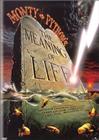
MONTY PYTHON'S THE MEANING OF LIFE


Written by El Mono Santo

The Monty Python troupe... You either love them or hate them. In my youth, I adored them. I formed and was President of the Monty Python Club (officially the Dead Parrot Society) senior year of high school. I never laughed harder in my life than the first time I saw that bovine get launched in Holy Grail. And who among us will ever forget the penalty for saying “Jehovah” from Life of Brian? But I never liked Meaning of Life.

Meaning of Life is not horrible... The soundtrack is hilarious and the film has its moments. But overall, I've always thought of this as their big flop. Considering that its artists speak multiple languages, are educated at some of the most prestigious institutions, and have an exceptional knowledge of everything from philosophy to history to art, I hoped for their erudite sophistications to come through in a film which purposes to answer “the big question”. Except for a brief mention of Schopenhauer, my hopes were frustrated. In the end, the answer to the question of the meaning of life is this:


“Try and be nice to people, avoid eating fat, read a good book every now and
then, get some walking in, and try to live together in peace and harmony with
people of all creeds and nations.”


I, of all people, know the Pythons better than that. The real meaning of life that the Python's preached--the meaning that is presupposed in the songs, skits, and actual structure of the film itself—is that life is ultimately absurd. The Pythons used comedy as an expression for their view of reality. Since the vast, empty, impersonal cosmos is ultimately greater than man and there is nothing beyond or greater than that, the film focuses on all the different so-called “stages of life” in humanity (from birth to death and the big Christmas party at the end) that are the only things that make man who and what he is. Therefore the meaning is simply to be as you are. A man lives, breathes, shits, and hopefully has some fun along the way, therefore go and do so, amen.

It is ultimately an anti-philosophy or an anti-meaning. The Pythons have failed to find an answer because they never believed there was one. The film is a mockery of life, not an attempt to find its meaning. Along the way, it turns this anti-philosophy on the most special moments of life in order to show them up as fraudulent. Before the credits roll, even the voice of the Pythons is silenced in the great meaningless nothing of space.

To quote an earlier film, "you come from nothing, you're going back to nothing, what have you lost? Nothing."

Friday, August 18, 2006

GIRL, INTERRUPTED

Written by El Mono Santo

I've wanted to see this film since it first came out. What young adult male would pass up those dark, expressive, captivating eyes (Ryder) or that wide smile and the super-sized lips begging to be kissed (Jolie)? But Ryder was so thin and skeletal, I kept having flashbacks of Natalie Portman in V for Vendetta who looked like a starving Ethiopian (minus inflated stomach) or a sexless fetus. I know an emaciated look was important to the film and several of its characters, but it seemed obvious that the lighting crew, make-up artists, and other craftsmen only had to bring out what was (not) already there.

The acting was better than I anticipated and I enjoyed the cast. The characters were fun and our two leading ladies compelling. Although it had nothing that would split your sides, there were quite a few places that tickled the funny bone—including an unintentional bit of cinematic soothsaying at the opening in which Ryder apologetically recollects through interior monologue: “have you ever...stolen something when you had the cash?” And the structure of the film, broken and disjointed, shifting us through various moments of life, pulled us into Ryder's clouded, subjective world very effectively.

Unfortunately, the film wasn't complete—even with a few deleted scenes that should have been included to make better sense of different situations and characters. It seemed more like a series of events we followed which pretty much ended where it began and gave few answers. Since this was adapted from a novel which had no typical plot line structure, perhaps we can be a little forgiving.

It followed the theme of insanity and inability (or refusal) to grasp truth by giving conflicting perspectives. The film concludes with the idea that you should leave one world (the world of rebellion and the pursuit of dreams or fantasies) for the other (the world of control, decision, truth, and judgment), but this is questioned at several points. Maybe it's the doctors who are crazy and the patients sane. And what is freedom? Is it getting out of the institution and back into the world where you do as you are told or allowing yourself to experience life the way you want no matter what anyone else says or thinks? The rebellious and revolutionary make the wrong choices and therefore are mentally ill (yikes!), or perhaps we are all mentally ill to a greater or lesser extent. All these options are presented and none really refuted, clouding the overall message.

This is ultimately a morality tale. It made truth the doubled edged sword--the hinge on which the lives of people swung either to better or worse. The lives of the characters spiral from life to death as they deny or interrupt truth. It is not until they stop running from truth and face it that they break down and have a chance to change for the better. The “moment of truth” comes for Ryder with the death of her friend in which she faces truth and breaks down in the solace of her stalwart mentor. Jolie's moment comes from reading Ryder's diary about how various characters hide from the truth instead of facing it. When the rough and tough chick demands that she be uncovered as well, Ryder obliges and it is almost too much for Jolie to take. But we see in the final scenes that this is a turning point for her as well when she cries and admits the truth of her position to Ryder, saying “I'm not really dead.” So the truth not only saved and set free Ryder, but is on course to save and set free Jolie as well.

Tuesday, August 15, 2006

DONNIE DARKO


Written by El Mono Santo

So I finally saw the film. Seems to make everyone's top ten, twenty, pick your number, greatest films of all time. Also seems everyone who's seen it recommends it highly, while everyone who hasn't seen it has no clue it even exists. I was formerly one of the ignorants, but cumulative praise via word of mouth finally sent me on a mission to Blockbuster.

As anyone who takes a gander at my favorite film list will immediately see, I've got a special place in my heart for Post-Modern films...not to mention music, art, and almost everything else in that stream... So this film did not fail to delight and excite--even if I happen to disagree with it fundamentally.

Donnie Darko is, basically, mysticism or romanticism for the Existentialist. I guess this was too much for the U.S. audience, so they had to market it as a horror teen flick. But in a way, horror and teen are also what it's all about. The protagonist is a young man suffering from what one philosopher called "angst" but which is better termed existential despair--something Post-Modern youth (like myself many moons ago) really, really get--not just in terms of understanding, but in terms of individual existence. While the film is very good, what makes it top the charts or hit home is this ability to communicate at a fundamental level what defines so many in this era of the Western world. But that is also precisely a fundamental reason why this film is self-contradictory.

Donnie is the Post-Modern superhero. Unlike Superman, who stands for truth and justice and fights against those who twist things to error so that a happy ending is not perverted, Donnie stands for finding meaning in the chaos, for creating his own truth in a world without it, for being able to face the unhappy ending with a smile because of the journey to that end. The road of Existentialism--either in the philosophy books or in this film--is a non-rational personal experience that gives hope and meaning to face a reality that is too much to bear and that would ultimately be better off destroyed (either in reality or outside it).

Like Sam Lowry in the Gilliam edit of Brazil, Donnie destroys the world by going insane--at least, that is how to describe it from outside the Post-Modern world-view. In the world-view of this film and many living in the world today, Donnie has not lost hold of reality, he has conquered it in the only way available to him until the end. He has saved himself and become the Existential savior. That is what makes him a comedic character instead of a tragic one. And it is also something that can inspire and give non-rational hope and meaning to other Existentialists who, living a self-contradictory existence anyway, will not mind defining themselves by the same token--in fact will glory in it.