Showing posts with label Carlito de Corea. Show all posts

Tuesday, November 14, 2006

LIGHTS IN THE DUSK


Written by Carlito de Corea

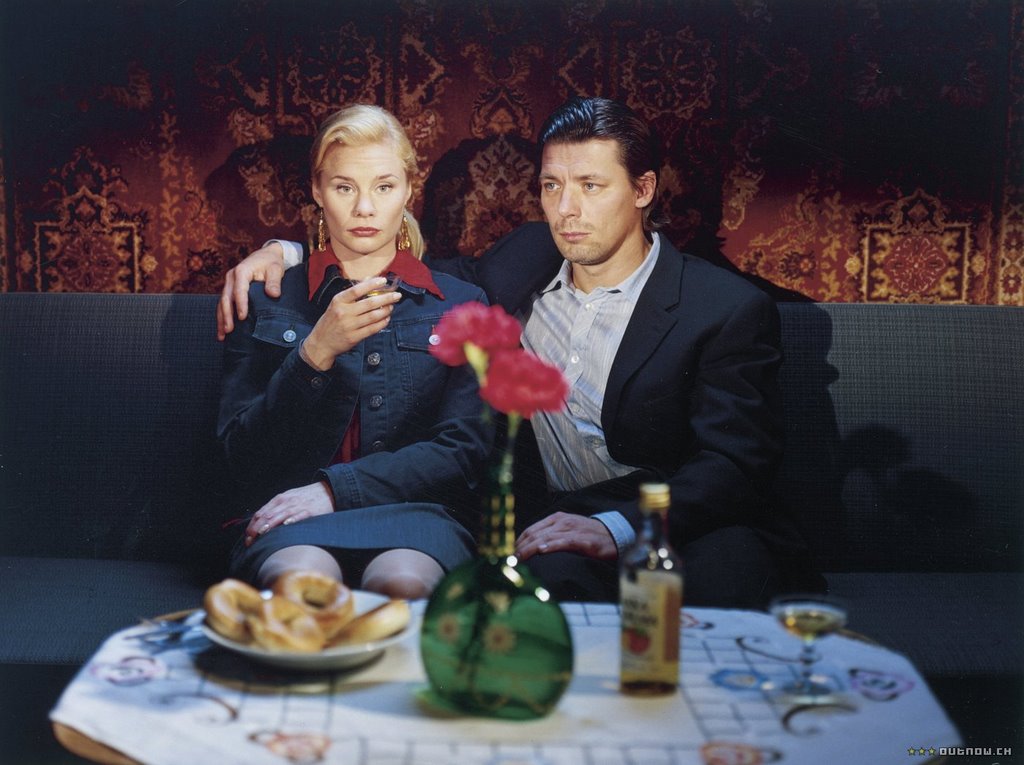
In his new film, Lights in the Dusk, Aki Kaurismaki strikes our sense of irony and compassion from the beginning as we follow the hero of his story, Koistinen, through a series of misadventures. It is the third film in a trilogy, following Drifting Clouds and The Man Without a Past.

Koistinen is apparently subject to unexplained scorn from everyone he encounters, and as there seems to be no reason for the treatment he receives, we are both compelled to laugh and feel sympathy for him. For a while his luck appears to take a turn for the better when the seductive blonde, Mirja, takes an interest in him, but we soon realize that this too will prove to be a problem. His failure is both funny and moving, as even his attempts to reach out to a neglected dog, whom we sense somehow he identifies with, seem to go wrong.

At times I was reminded of Hal Hartley’s Henry Fool, as Koistinen, dressed in his security guard uniform, wanders from one caustic encounter to another. And as with Hartley’s work, while there is a sardonic demonstration of the cynical world surrounding his characters, there is at the heart of it an underlying lack of cynicism, a compassion for the outsider.

At the same time, I was strangely reminded of Ingmar Bergman, as the camera would suddenly focus on some scene in nature, a growth of wild flowers in the woods, for example. The cinematography, the European feel of Kaurismaki’s work, gives it a different feeling, a muted quality that seems to offset the irony, or absurdism, somewhat. But these elements in his film are somehow complimentary, rather than contradictory.

Lights in the Dusk is a poetic, ironic look at the hard edges of life, which Kaurismaki softens with his particular sensibilities and makes enjoyable to watch. The film is understated, and while perhaps at times slow, I found its blend of pathos and deadpan humor effective and entertaining. Kaurismaki juxtaposes the aspirations of his hero with the indifference, and even maliciousness, of a glib, calloused world in a way that is both touching and funny. I also felt that at the heart of it, along with its sense of beauty, was an underlying hopefulness, an affirmation that things can work out, even for the loneliest people.

These qualities, for me, made Lights in the Dusk a film worth watching. I recommend seeing it.

Monday, November 06, 2006

THE BOSS OF IT ALL


FROM THE PUSAN FILM FESTIVAL
A report from Carlito de Corea

In his latest film, Lars von Trier uses a metafictional approach to deliver a satirical narrative. That is to say, he tells us that he’s telling us a story, and how. Sort of. The Boss of it All begins with the narrator, perhaps von Trier himself, letting us in on the joke, as he tells us his film is not to be taken seriously, nor is any serious meaning to be taken from it. Just another typical story with the usual parts and players, he continues, having fun as he once again blows apart the apparatus of conventional storytelling.

The boss of an IT corporation hires an actor to pretend that he is the boss of the company during an important negotiation to sell the company off. Circumstances become complicated as the real “boss of it all” and the actor pretending to be “the boss of it all” begin to butt heads about how things should be handled. Romance and sexual exploits also crop up as office workers in the company mistake the actor for someone else, and tensions between the owner of the Icelandic corporation intending to buy the IT corp. and “the boss of it all” escalate.

Von Trier lets us in on the game in this film as it periodically describes its own constructs. But this apparent self-consciousness is misleading. While the film gives the impression of letting the cat out of the bag, so to speak, the comedic tension is never lost and the narrative continues to move forward. The simultaneous accomplishment of poking fun at the process of drawing in an audience with all the typical and corny constructs of storytelling and then drawing the audience into a corny, constructed story, is quite a statement.

Another interesting effect in this film is the fine line between what the actors are going through and what the characters are going through. It is almost as if the actors are waiting for the director to fill them in on what the story is or where it is heading next, rather than the employees at the company being confused about who their boss is. This is a wonderful illusion, or perhaps not, that helps to create the feeling that no one knows what is going to happen next, neither the audience nor the actors, as the story whimsically and absurdly changes direction at various moments.

I thought the film was successful in managing these different elements, blending a seemingly loose and spontaneous style with a deceptively well-controlled narrative, and tight, well-acted scenes, all of which climax in a humorous and touching ending, albeit a self-conscious one. Well written and directed, this movie is just fun to watch, and at times laugh out loud funny. It was a big hit at the Pusan Film Festival this year and I recommend seeing it.

Thursday, November 02, 2006

JINDABYNE


FROM THE PUSAN FILM FESTIVAL
A report from Carlito de Corea


Director Ray Lawrence takes a longer look at some of the questions raised by Raymond Carver’s short story, “So Much Water So Close to Home.” The same story was covered, but in less detail, by Robert Altman’s 1993 film, Short Cuts.

The film revolves around the racist killing of an Aboriginal woman, and the subsequent mistakes made by a local group of fishing buddies, led by Gabriel Byrne, who find her body. You may remember the part in Short Cuts where Fred Ward is on a fishing trip and finds a dead girl, and the troubles he faces with his wife when he gets home.

Lawrence does a great job of showing how something innocuous can become a serious indictment in the blink of an eye. What seems a harmless decision by the four friends about what to do with the dead girl’s body, later takes on enormous implications where much more is read into their actions by the media, the Aboriginal community, and even the people closest to them.

Back in civilization proper, the men begin to realize the seriousness of what they’ve done, emerging from the spell of their trip. As their deeds come to light, and they are assailed by their community, we realize that we too have been seduced into forgetting for a moment what the right and proper thing would have been to do. We are almost complicit in their actions.

As with all great stories, Jindabyne makes us understand both sides of the dilemma. There are no villains, only real people, with the exception of the killer who remains unrecognized in their midst, and whose presence we feel implicitly throughout the film.

Interestingly, I found the tone of this film reminiscent in some ways of Short Cuts, the stark natural sound at times underscored with an ambient, and alternately menacing, soundtrack. But for me there was something in Jindabyne, in tone and feel, beyond the dry quirky feel of Short Cuts, something richer, even reverent. With Lawrence there is a heavy reliance or trust in the environment, a willingness to foreground the natural elements to create a deeper experience, utilizing nature as a character in itself.

And in Jindabyne I wondered if Lawrence wasn’t suggesting that we are missing something that perhaps native peoples are in touch with—the animate, or animus, in what we often do not think of as alive, such as the often-shot wind in the trees, or the thrum of the power lines over the heads of the men as they descend into the gorge toward the river to begin their fishing expedition. We don’t just watch Jindabyne, we feel it.

Like his previous film, Lantana, Jindabyne is slow but steady. The plot is not as intricate, but is equally suspenseful. Even when nothing is happening, you find yourself engrossed in his images somehow. Lawrence has the patience to study a scene, a character, for longer than the average director, and yet without leaving the viewer with the impression that it is mere indulgence. There is always something behind what we are seeing, an underlying tension that Lawrence is so good at sustaining, both through the creation of characters we feel and care about and well-layered storytelling.

The Australian cast lends a lot to the authentic, small town feel of Jindabyne, and the Irish auto mechanic, played by Gabriel Byrne, is especially interesting to watch in this film. Jindabyne held my interest from its violent start to its emotional finish. I recommend it.

Friday, February 17, 2006

SYRIANA


by Carlito de Corea

A strong ending makes up for what felt like a tedious and confusing film much of the time, revealing a greater degree of coherence than was initially apparent. The build-up toward that end, however, is complicated and at times seems so esoteric that we are left feeling almost inadequate, unable to get emotionally or even intellectually involved. Still, I recommend Syriana, with the reservation that the labor involved in trying to keep up with the multiple, often obscured, storylines might be too taxing for many viewers.

If “Syriana” bears any lexical relation to the term, “Americana,” then it means, “About the Middle East,” or “Things characteristic of the Middle East.” Syriana is told in a fleeting, almost stream-of-consciousness style, and begins by placing us in the center of scenes for which no context has been established, cutting from one set of characters to another, each occupying different, as-yet-un-discernable storylines. The film is written and directed by Stephen Gaghan, who also wrote the screenplay for Traffic.

There are essentially five storylines, depending on how you divide them, which are all eventually brought together in the end: the story of Bob Barnes, the CIA assassin, played by George Clooney, who is being retired by the agency; the story of Washington lawyer, Bennett Holiday, played by Jeffrey Wright, and the merger between the Connex and Killen oil companies; the story of the emir and his two sons, Prince Nasir and Prince Meshal, both potential heirs to his kingdom and its oil fields; then there is the story of Bryan Woodman, the financial consultant, played by Matt Damon, who becomes a confidant to Prince Nasir; and finally, there is the story of Wassim and his friend, Farooq, the disenfranchised foreign workers who are ultimately influenced by radical Muslims.

The film jumps back and forth between these main storylines, presenting small parts of each narrative in succession, sometimes even taking the time to focus on a minor aspect of a larger storyline, like Bob Barnes’ problems with his son, or Bryan Woodman’s struggle to keep his family together. The film also jumps to the many geographic locations that each of the main stories brings us to.

To help explain the film a little, if that’s possible in a short review, it might be easier for anyone planning on seeing this film to consider the story of the emir and his two sons as the central hub through which the other stories flow, or ultimately converge. This narrative is never developed, but is rather implied, acting more as a conduit for the other storylines in the film, although much of the film and its various narratives are also implied. In any event, all roads lead to the Middle East (coming from Texas and Washington).

Bryan Woodman, the consultant based out of Geneva, is working together with Prince Nasir, portrayed as the better, more conscientious prince, to reform his country and reduce the bleeding of their profits to foreign interests. Meanwhile, Connex and Killen are courting the other prince, Prince Meshal, whom it appears they can control, and who it appears will be heir to his father’s kingdom. They are also trying to get him to break an existing contract the emir has with the Chinese government. Basically, I would advise looking at the film this way: Bennett Holiday, and everyone associated with his firm, and with Connex and Killen, bad; Bryan Woodman, and the forward thinking son, good. Then there is Bob Barnes, who is caught in the middle, and paradoxically, as an assassin, is our moral barometer in the film.

There are also the foreign, or migrant, workers who have been fired from their jobs at the oil fields due to a takeover by the Chinese (replacing Connex), and who are generally mistreated at the bottom of the food chain, so to speak. Their story only relates to the other storylines tangentially in the end, but not inappropriately so. In fact, symbolically speaking, it is precisely appropriate that their story is less integral, as they are part of the disenfranchised masses, irrelevant cogs in the capitalist machinery. In so being, they are also vulnerable to radical, ideological influences, and as Syriana shows, are the X-factor, the joker in the deck we cannot predict.

The effect of Syriana might be described as a mosaic of simultaneous imagery, where the five or more stories are almost, in essence, coming at us at the same time. By seeing a short part of each narrative in succession, the viewer begins to feel present in all the various places and storylines at once. The effect is a kind of ubiquity, as I might feel in a dream, suddenly finding myself in various locations within a short space of time, but where things also don’t exactly make sense. The film also employs a sense of realism, however, but a subjective realism. Oblique camera angles and hand-held shots contribute to this feeling. There often seemed to be the sense that we were viewing the central action through a corridor of visual obstructions, people left out of focus, or a simple column or cupboard crowding the edge of the frame, so that we are always looking past or along something. This gave the film an insular quality, the feeling of watching in secrecy, or perhaps experiencing the tunnel vision of a dream. This feeling is further enhanced by the use of natural sound, combined with an ambient background music that reminded me of the music of Tangerine Dream.

While the film is achieving this ambient, beneath-my-conscious-level feeling, however, it also left me with a sense of being lost, or disconnected. Information comes fast and fleetingly, often in the form of some apparently off-handed remark, or some mumbled phrase from one character to another, under their breath, but which also happens to be a key element of the plot. Important information goes by so quickly that it’s hard to keep up, and then we’re off to another location, to another set of characters.

Of course, Gaghan is trying to bring us into the film from the inside, so that he can eventually pull back to give us a wider view, perhaps to achieve some of the effects discussed above, or perhaps to increase the impact of the ending, rather than taking the usual outside-in approach. Syriana drops us smack in the center of things, for better or worse, leaving us to fend for ourselves, so to speak. But this up-from-the-inside approach, combined with the abundance of storylines and the obscure manner in which exposition is presented, makes the film hard to follow, and for much of the time I really had no idea what was going on, leaving me detached, and even bored at times. I just sat back feeling left out, like I didn’t have enough political knowledge to participate in the film.

As far as the acting is concerned, the only distraction, I felt, was Matt Damon. I really didn’t think he carried his weight in this picture. He seemed to pale beside his “Middle Eastern” counterpart, Alexander Siddig, at crucial moments, as when he is scolding the prince for having no business sense. Rather than impressing us as the frustrated but impassioned observer revealing the truth in brutal terms to his new client, the character comes across as melodramatic and petulant. His delivery of these key lines seemed out of place, reminiscent of the diatribes we saw in Goodwill Hunting. At times, however, he wasn’t bad, and frankly, Gaghan should have exercised better judgment, or at least control, over his actor. He simply shouldn’t have settled for the scenes as they were.

George Clooney. George is an actor I don’t want to have any problems with. I like George. I’m always rooting for him, wishing he would be still, believe in his presence, which he does have, and much of that comes out beautifully in this film. At times, though, I felt I was seeing some of the usual George Clooney quirks coming through the performance, like his trademark head-bobbing. But much of the time, if not most of the time, Clooney was right on the money in this picture as the depressed CIA assassin being set out to pasture. But this was when he wasn’t trying so hard, relying on his presence and letting the character just be. The rest of the cast was strong, I felt. Jeffrey Wright was especially impressive in his understated portrayal of Bennett Holiday.

Storylines do begin to converge about halfway through the film, or later, and we finally begin to get the sense that the seemingly unrelated pieces of this complex mosaic are starting to make a larger picture, even if we don’t exactly understand what it is. Bob Barnes’ first return to Beirut marks a definite turning point in the film. Things pick up from there. At this point we begin to feel that Syriana is going somewhere, that the stakes are mounting and some significant resolution might take place.

Despite its complicated construction, I recommend Syriana. It is one of those movies whose ending has the retroactive effect of suddenly making the whole picture seem better, and making us realize that there was more to it than we may have initially realized, that beneath the confusion there was substance after all. For people who liked Traffic, you may already be inclined to enjoy Syriana, as both films were written by Stephen Gaghan, and bear much of the same structural approach to telling their story, with Syriana revealing government (American) corruption in the Middle East and Traffic showing the same thing in South America. As well, the film is visually satisfying, as I have described. There is a real sense of going on a journey, through a few dark tunnels, so to speak, and I enjoyed the “subconscious” feel of it.

In the end, I believe, I felt what director Stephen Gaghan wanted me to feel: stunned, and perhaps a little bit more aware, if I wasn’t already fairly suspicious, just how deep the connections run in Washington between the oil companies and espionage, between business and terrorism. I look forward to a second viewing of Syriana.
Tuesday, February 07, 2006

NORTH COUNTRY


by Carlito de Corea

Misogyny is the theme in North Country. Based on a true story, the film tells the story of Josey Aimes, who takes on the Pearson Mining Company over allegations of sexual abuse. The story begins in the courtroom, where Josey, played by Charlize Theron, is answering a series of degrading questions. The film flashes back to where it all began, intermittently returning to the courtroom until the story is under way.

The story proper begins with Josey leaving home, with her kids in tow, to stay with her parents because of domestic abuse. The husband in this case is generic. We never see him, except obscurely when Josey is fighting with him on the lawn of her parents’ home almost immediately after leaving him. This scene is a strong indicator of how things will go, both for Josey, and for we the viewers, as her father watches without helping and makes cynical remarks about her being a troublemaker. The tone is heavy from the start and never lets up, until the end, when it swings wildly in the other direction, to a sentimental catharsis in court that ultimately ruins some small ground the film was beginning to regain.

Back in the courtroom, the company’s attorney asks Josey when she first started working at the mine. We flash back to a local bar where she first meets her friend Grace, played by Frances McDormand, a union rep and employee of the Pearson Mining Company. Over a beer and a game of darts they become friends and shortly thereafter Josey is also working at the mine. From here the film describes excruciatingly the degrading conditions the women at the mine have to endure: endless litanies of derogatory, sexually explicit remarks and unwanted advances by their male co-workers.

A recent court decision has forced the Pearson Mining Company to allow women to work at the mine, and, as a result, new female recruits experience open hostility and resentment. They are also subject to the constant threat of rape. “Cunt,” one man says under his breath, passing Josey in a hallway as she is being led to her first assignment. “Who’s gonna be my bitch?” another man says just after this, as their foreman turns them over to another employee for work detail.

Things get so bad that Josey is forced to quit her job at the mine. She decides to take legal action and enlists the help of Bill White, played by Woody Harrelson, a lawyer and friend, and one of the only two males realistically portrayed in this film. Josey encounters resistance from everyone, including her own family—namely her father who himself has worked at the mine for most of his life—and from the women who still have to work there and don’t want to make waves. She tries to get her fellow employees to stand with her, to stand up for what’s right and make it safe for women to work at the mine. She only needs three more women to join her and her case can be filed as a “Class Action” suit, setting a legal precedent and giving them a better chance of winning.

While the story and theme in North Country are interesting, and the film is at times moving, its portrayal of misogyny is unfortunately too cynical and exaggerated. From the start we are subjected to a constant barrage of unrealistic male characters. With one or two exceptions, the men in North Country are all menacing sociopaths, one-dimensional characters with no moral fiber whatsoever, their behavior more closely resembling that of prison inmates. So much focus is put on describing men as leering, salacious pigs—it seems like there is one waiting around every dark corner—that the portrayals become cliché, over the top, and we are no longer interested in them, except as comic book villains whose only purpose it is to draw us cheaply and reflexively into condemning bad people and cheering for the hero of the story.

The pitch of negativity reaches its climax at a company meeting devoted entirely to deriding Josey and further ensuring that everyone remains against her so that she doesn’t win the lawsuit and everyone can keep their jobs. Bobby Sharp, played by Jeremy Renner, Josey’s primary nemesis, and part of a subplot which I won’t reveal, delivers a speech full of derogatory expletives directed at Josey that has the entire town hall hooting and hollering over her demise. Josey enters the meeting with her lawyer and friend, Bill White, summoning the courage to speak out and demanding her right to speak at the microphone, whereupon she is booed and jeered and told to get lost. Determined not to give up, Josey carries on, making her way to the podium amidst the deafening clamor of crude remarks. She tries to appeal to the hardened crowd, delivering an emotional speech that for a moment seems to be having an effect. Surprisingly, the miners stop booing and we wonder for a moment if she might not turn the crowd in her favor. But once again the jeering starts.

“Hey Josie, show us your tits,” one man shouts, triggering another deluge of lewd remarks.

Having had enough, Josie’s father, Hank, played by Richard Jenkins, walks to the podium and instructs his daughter to hand over the mic. Crushed and no longer able to defend herself against what could prove to be the ultimate final insult, she stares at her father helplessly, pleadingly. Is he really going to silence her, we wonder. Or might he possibly, finally defend his daughter against this lunacy. We are overcome by a long needed release of tension when Hank takes the microphone from his daughter and rather than walking away takes a place beside her at the podium. Both Theron and Jenkins deliver powerful performances in this scene, and like Pavlov’s dog I responded to it. But I did so begrudgingly, aware all the while that this basic and obvious component of compassion was artificially withheld from me in order to achieve this effect.

This scene also had the unfortunate effect of reminding me why much of what I had seen so far was now even more implausible: HER FATHER WORKS AT THE MINE AND HAS FRIENDS THERE!!! Most men do not badger and sexually harass their friends’ daughters, or their colleagues’ daughters, and most likely would not put up with it from other people as well. I personally don’t know any men who wouldn’t at least say, “Hey watch your mouth,” when someone was calling his friend’s daughter a bitch and a whore. The scene also ends with another unlikely occurrence. Everyone starts clapping after Hank delivers his speech, in which he told them how ashamed he was of them all and that he had no more respect for them. Why would you cheer your own denunciation?

At this point, however, complaints of inconsistencies at the town hall meeting aside, I felt that the film was becoming more reasonable and might become more interesting. That is to say that some of the key characters were becoming human, finally, and the film, subsequently, more realistic. There is a nice moment when Josey is back at home with her father and mother, played by Sissy Spacek, and the family finally seems to be coming together. Her father gets up from the table at one point to embrace her when she breaks down and says she doesn’t know if she can take any more. As well, there is a tender moment between herself and her oldest son, Sammy, who finally seems to relent after feeling resentment and hostility toward his mother for the pressure that her infamy has put him under. Unfortunately, however, the film then swings too heavily toward the sentimental, delivering a soppy courtroom ending that borders on the absurd, and shows as much insight into courtroom proceedings as it does into male psychology.

A good cast makes much of the exaggerated treatment of this subject bearable, and I admit to being drawn into the story at times, but, unfortunately, I found myself too often wanting to be drawn in more than I was being drawn in. Too many exaggerations and a constant sense that the chips were unrealistically stacked against Josey kept me from warming up to North Country. The depiction of men in this movie was also disappointing. The type of aggression toward women described in the film should perhaps have been characterized as the exception rather than the rule, if for no other reason than to create a greater degree of tension in the film, a greater degree of balance, even if the events described really happened and the majority of the men at the mine were evil and cowardly in real life.

Saturday, February 04, 2006

ELIZABETHTOWN


by Carlito de Corea

If you like to watch films that reflect the difficulties of ordinary life, the pain of true loss, and then some hard fought redemption, or perhaps resulting ruin, something that you can relate to, see your own suffering in, then Cameron Crowe's new movie, Elizabethtown, will not be for you. If, on the other hand, you simply like to escape daily life and enjoy a good movie with a good story, then…no, maybe Elizabethtown still won't work for you.

The film begins with Drew Baylor, played by Orlando Bloom, making his way toward an expensive looking corporate office, the headquarters for Mercury, the shoe manufacturing giant for whom he works, perhaps a parody of Nike. We realize something is not right for him as he enters the building and makes his way through the palatial concourse toward one of the building's boardrooms, where we sense some terrible fate awaits him. “I'm ok,” he says repeatedly to some of the people he passes. This peculiar behavior sparks an urge to laugh out loud, as it clearly implies the opposite, that he is not okay, and that he is walking toward some monumental disaster. I have to admit that this movie did hold my attention for a few minutes, and that I did laugh out loud. I wondered what in the world was going to happen to him. I was ready to sympathize, to empathize, as yes, we too feel the weight, daily, of the corporate bullies crowding us out, shrinking our burgers and raising the prices on everything we come near. And we don't even dare to think of actually working for them. Yes, this could be good. Drew is our whipping boy. Go get 'em, brother.

After sort of being informed by his boss, played by Alec Baldwin, that he would be taking the fall for a particular line of shoe that has lost the company nine hundred and something million dollars, and to which he was closely linked, if not entirely responsible for, Drew returns to an expensive home, as progressive looking as his office, and begins to rig his stationary exercise bike with a huge kitchen knife that will stab him through the chest when he turns the machine on. The tension is humorously released when his cell phone begins vibrating on the kitchen table. Annoyed and not even able to commit suicide properly, he succumbs and answers this one last call, only to find out that his father has died and that his family is now relying on him to go to Elizabethtown, Kentucky, to take care of funeral arrangements, and straighten things out with his father's side of the family. Unfortunately, the initial feeling that any number of incredible and unexpected things could happen to this character soon gives way to a litany of trite, uneventful circumstances. The pathos in this early sequence is never returned to again, and soon after it the film begins to lose its integrity.

His suicide postponed, Drew is now forced back into the arena of life, and so embarks on what is the main narrative of the story, heading into the past while trying to work out the present, and meeting Claire, played by Kirsten Dunst, and falling in love with her. He arrives in Kentucky to a heartfelt, near-parade of a welcome, accompanied by nostalgic music and some cool images of small town America as he cruises through Elizabethtown in his rented car. But instead of settling down into a heartfelt journey of self realization, or personal hardships and conflict, Elizabethtown digresses into an assortment of styles and loosely arranged scenes that barely cohere. We see problems early on when Drew arrives at his father's wake and the film tries to achieve a deadpan quirk, a la The Coen Brothers, laying it on thick with dumb lines and heavy pauses between them to accentuate the stupidity of the characters, of small town folk as it happens, a cliché that small-town folk, maybe even from Elizabethtown, won't much appreciate, I'm guessing. Many scenes in the film seem to be all about the attempt at this type of humor, becoming the focus of purposeless moments, like the drunken newlywed man Drew encounters while stealing beer from one of the rooms at his hotel, a scene that is not only self-conscious and contrived, and patently unfunny, but poorly acted as well. The film slips in and out of this type of irony and realism, returning to Crowe's more usual sentimental tones when the film returns to its focus on Drew and Claire.

Getting the most out of his actors, or even concern over the acting in this film at all, doesn't seem to weigh heavily on Cameron Crowe's mind. The casting of Orlando Bloom, for example, is questionable, although a whole lot better than his purported first choice, Ashton Kutcher. At times Bloom seems uncertain whether to add to the effect of irony Crowe is often trying to achieve with his own expressions, or to hold back and play it straight. But worse than this, Bloom seems throughout to possess an irrepressible confidence, even smugness, that undermines the desperation Drew is supposed to be feeling. He is simply too glib, and as I watched the film I wondered whether he might not be more comfortable with a quiver of arrows on his back or a sword and some swashbuckling pirate's outfit, winking at the camera with that confident gleam in his eye. He lacked the inner turmoil we have seen from actors like Cruise in previous Crowe films, or John Cusack in many of his performances. Bloom is a decent actor, but is perhaps miscast, or at least misdirected, in this film. He just exudes too much confidence for a man on the brink.

Before arriving in Kentucky, Drew has encountered the already-loyal, undyingly enthusiastic Claire, the only stewardess on a flight where he is also the only passenger. This encounter, which most of us can of course relate to, signals perhaps the biggest problem with this film. There is utterly no conflict. In Elizabethtown everything works out, and nothing acquired comes with any difficulty. Drew simply breezes through one scene after another with everything falling into place as he goes. There is no loss, no pain, no catharsis. Where's the recoil from the loss of a billion dollars? And Claire, despite being an airline hostess whose job it is to travel all over the country, always manages to be there beside him at his hotel in Kentucky, where he is either in the process of preparing for the memorial for his father or arguing with his father's side of the family over whether to cremate his father's body or have him buried in the traditional way. And she understands him…fully. Throughout the film we simply watch them come to like each other more and more. The closest their relationship ever comes to danger is when Drew appears for perhaps fifteen seconds to be distancing himself from her because of his inner turmoil over losing Mercury a billion dollars. She responds, as with all things she discusses, by basically saying she understands everything. Problem solved.

The film crescendos with a banquet, where the tension of a vague subplot relating to some long held feud between Drew's mother, played by Susan Sarandon, and father's side of the family, is finally released. But this moment only highlights, once again, that Crowe has little control over his material, or has poor material he is trying to give meaning to. The latter seems closer to the truth. The film at this point is supposed to have some cathartic significance, with Sarandon's character delivering a speech in the form of a comedy routine, because…she's been taking standup comedy classes…because…well, she's been working stuff out. Somewhat on their own among the Kentucky side of the family, Drew's immediate family experiences a collective catharsis, as Drew and his sister sit at a table at the front of the hall surrounded by the slightly hostile relatives and nervously watch their mother deliver a eulogy that comes dangerously close to being inappropriate and threatens to pull them even further out of the family's ambivalent graces. Fortunately, however, their mother wins everyone over with her routine and once again everything works out. The only problem is that Sarandon's comedy routine is inappropriate and completely unfunny, so idiotically inappropriate and unfunny that the only way any group of people under any circumstances would have laughed at it is if they had been under the influence of LSD.

As with many “nice” moments in the film, they often seem to have been conceived separately, and based rather on a preference for particular songs than on concern for the overall coherence of the work. Crowe almost seems to direct around his desire to highlight some of his favorite music. Claire and Drew's musically accompanied skip through the graveyard, for example, seemed particularly irrelevant to the film. The music itself too often seems to be the film's lead character, and one gets the impression that ideas for his movies come to him while he's listening to a particular song, and that he can't resist putting those scenes into his films, along with the songs that inspired them. Admittedly, some of the images are beautiful and combined with his taste in music, which is also good, create moments that lift us up and make us want to rock out with the picture, with his sentimentality. Unfortunately, there is nothing to fall back on. We realize, after time, that the picture is just that-a lot of rock and roll imagery without much substance.

Of course, through all of this non-turmoil Claire is waiting in the wings, but, for god knows what reason-there having been no real indication in the film so far that he would choose not to be with Claire-we are now made to understand that Drew is just not sure of what the future holds, and needs to go off on his own. Do some soul searching. Claire, ever-faithful, bids him good luck and sends him on a rock and roll Easter egg hunt across the country. She has left him with a selection of music and directions for great rock and roll landmarks to visit, accompanied with her ragamuffin scrapbook full of sentiments and philosophies, as well as a trail of clues toward the end of his journey that will lead him back to her, back “home.” The final clue, a note left in a running shoe-yes the very one he is infamous for-in some shopping mall or market, has him turn around to see Claire standing there in the crowd, waiting for him as always.

This final, irrelevant touch is simply too much, and hits us with the force of a Vogon poetry reading. Elizabethtown is unbearable. Even for people with a sweet tooth, I don't think this film will work. By the end, the sugars from my snacks were coagulating in my blood and I was looking for the exits. Elizabethtown is so insipid, such a maudlin tour de force, that when the end came I was shaking my head in disbelief, desperate to get out of the theatre, to go and do something about the sickly sweet feeling coursing through my veins-take some medication, walk it off somewhere, discuss it with an anger management group, or maybe even talk to a police officer to see if there was any legal recourse, some way to retrieve that ten dollars. “Hey, man, those guys just ripped me off.

Thursday, January 05, 2006

LORD OF WAR

by Carlito de Corea

Nicolas Cage’s new film, Lord of War, of which he is also one of the producers, does not quite hit its target. The film opens with Cage’s character, Yuri Orlov, a Ukrainian arms dealer, talking to the camera, giving statistics about the ratio of gun owners, one in twelve, to the entire number of people in the world, concluding with a cheeky remark about his only problem being to figure out how to get guns to the remaining eleven. The film goes on to show Yuri’s progression from working in his family’s restaurant to becoming the world’s most successful and ubiquitous “gun runner.”

While the film is dynamic and stylish in its imagery and direction, the story telling is somehow not quite complete. The story progresses prematurely through each stage of Yuri’s rise to the top of the gun running trade. We go from his witnessing a gangland hit in Little Odessa, which rather than shocking him somehow motivates him to become a gun dealer, to his first gun sale in some hotel room, then to his already having connections in the middle east, and, finally, to facilely procuring the object of his arbitrary romantic obsession, a world famous model, of Ukrainian descent, all in far too few scene changes. The effect is that the story feels like it is being pushed along too quickly without proper development, and that the situations the characters find themselves in are being artificially arrived at.

As a result the film seems less substantial, and at times unrealistic. We feel this early on in the film when we see Yuri simply walk into a warehouse full of abandoned U.S. military weapons without any explanation as to how he was able to do this; and then later again when he conveniently has a relative who is a general in the Ukrainian military during the collapse of the Soviet Union, and is therefore able to obtain prodigious amounts of AK-47s and a host of other weapons and military machinery, by which he finally becomes top dog in the arms trade business, so to speak.

In the beginning, from the voice-over, I wondered whether this movie was made from the memoirs of an actual gun dealer, in the same way that Goodfellas was based on the Henry Hill memoir of his days in the mafia. I hoped that this might be the case, as I pondered the conspicuous absence of any exposition. That is to say, I hoped the lack of detail, the sudden appearance of Cage’s character in a variety of high stakes circumstances, was coming from a confidence in the facts of some memoir, rather than the absence of any logistical knowledge of the gun trade. In the end, however, it is the sense that the film’s creators only possess a vague, possibly researched, knowledge of the gun trade that predominates. Details are glossed over in too many places to create a realistic sense of danger or circumstantial tension. The bold, expedient pace, in the end, seems to serve the purpose of covering up narrative deficiencies, rather than taking stylistic liberties on the foundation of authentic knowledge.

This loss in the film’s realism is further compounded by the casting of Jared Leto as Yuri’s brother, Vitaly. Leto is too clean cut and good looking to be playing a gun dealing cocaine addict from Little Odessa, and he simply does not look like an Eastern European. Perhaps as an Orange County brat snorting cocaine he might carry some appeal, some credibility (as he did in Requiem for a Dream), but in Lord of War he stands out like…well, an Orange County brat…in the middle of West African and South American guerilla warfare…snorting cocaine. His character was distracting to watch. Ethan Hawke is passable as the Interpol agent on Yuri’s heels, although perhaps a little young for the part, or perhaps too boyish. We get the feeling that in this part any big name would have done the trick. Cage is engaging and for the most part enjoyable enough to watch as Yuri, although his voice-over seems to contradict his purported heritage, sounding more like a valley dude from LA than a street smart kid from Little Odessa. And the lethargy in this voice-over somehow seems out of sync with the pace of the film. A little too “laid back” for the frenetic circumstances that dominate the character’s life.

While the political point of view seems clear—people in the arms business are without conscience and are as responsible for the death that comes from the weapons they sell as the people who pull the triggers—in the end we are not sure whether to admire Cage’s character or condemn him. Is he the ultimate survivor in a corrupt and violent world, a realist, to be admired, or is he a rationalizing monster, to be condemned? Lord of War seems to straddle the fence on this question. While we can see that the answer is not simply that he is one or the other, but both, the film makes the mistake of trying to answer both moral positions, making the film sophomorically didactic at times. Perhaps a grittier and less apologetic view of the arms trade, and a little more confidence in the audience’s ability to discern the moral of the subject matter, would have strengthened the film.

Despite some of its shortcomings, however, Lord of War is not unenjoyable. The strength of its imagery and the sensual scenery of the South African location, and other various locations, carry the film a long way. As well, much of the action and special effects are quite dynamic and make the movie enjoyable enough to watch. Such moments as the landing of the cargo plane on a dirt highway in West Africa, as Yuri and his crew are being shot at by Interpol jets, for example, create visually powerful moments in the film that help make up for some of its other deficiencies. While this movie does not quite hit the mark as the heavy hitting political film that it perhaps intended to be, it does manage to be entertaining.